Why this exists.
I’ve taken my children to the events that are supposed to be for everyone — the Halloween walks, the firework displays, the Christmas light trails — and watched them get so overwhelmed we had to leave before the end. Too loud, too fast, too much. And I know that feeling from the inside. I spent my own childhood being called a daydreamer, told I wasn’t trying hard enough, that I needed to concentrate more — when really I was in environments that were never built for the way my nervous system works.
I gravitated towards Forest School because being outside was the environment where I could thrive. Then, for ten years as Forest School Leader at Franche Primary, I watched children like me — children who struggled inside a classroom — come alive the moment they stepped outside. Nothing to do with the child. Everything to do with the environment. It’s never that anyone is the failure point; it’s that the environment can’t bring the best out of them.
Interwoven Arts exists to build something different from the mainstream: places of light and sound where the most sensitive people aren’t just able to be there — they’re the people it was designed for. And where nobody watches from the outside, because everyone is making it together.
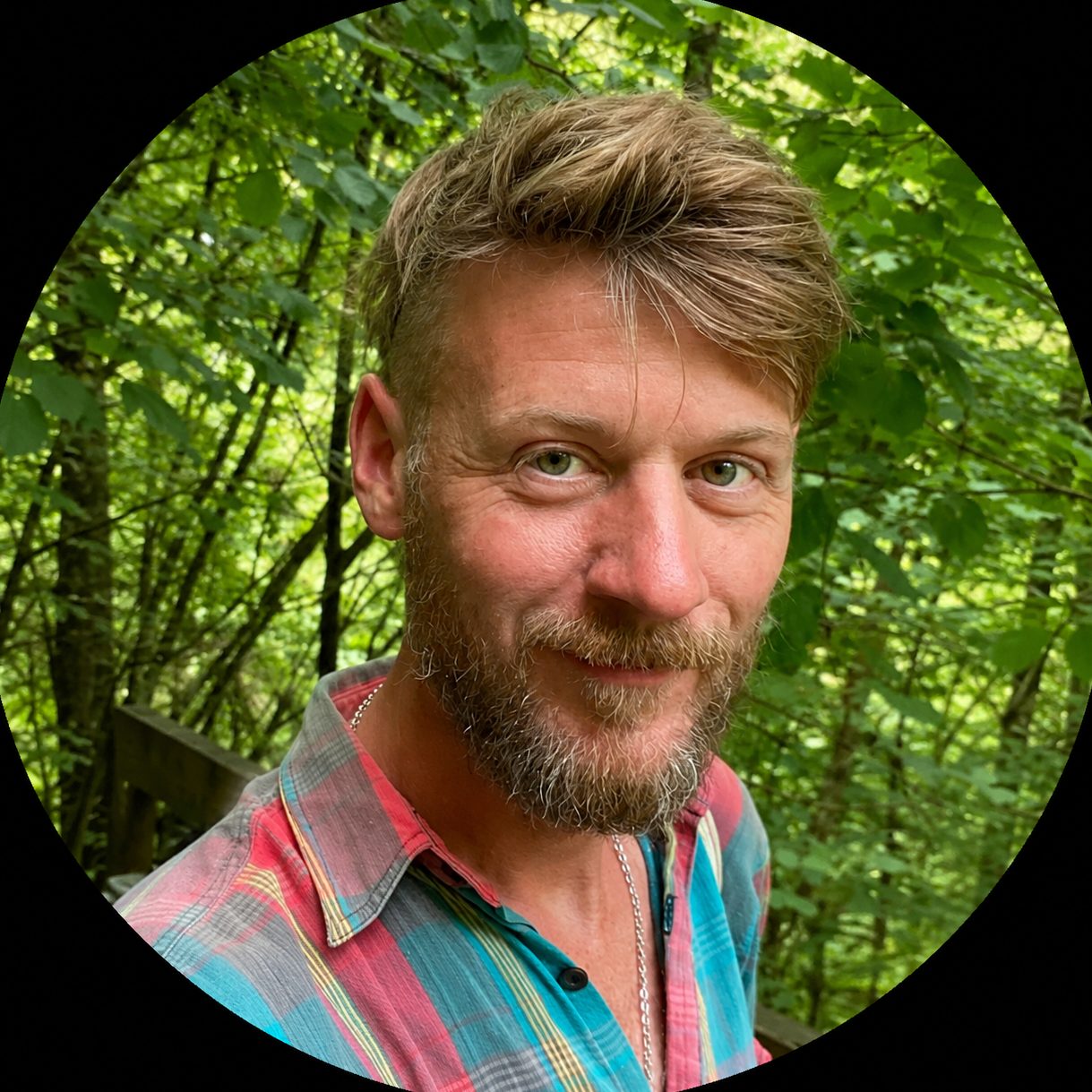
— Dan Gauden
founder & creative director
What we make.
Most of us understand the idea of a sensory room — light and sound in a quiet space, built to help someone settle and regulate. We take that idea out of the box and place it in a beautiful outdoor environment, where nature already does half the work. And then we go one step further: we let all the people inside interact and shape the whole experience.
Each installation has instruments (we call them modules) of light and sound, carefully placed to feel interwoven into the environment rather than imposed on it. Each can be directly played or interacted with — or responds to you: your presence, your movement, your touch. You’re not an audience. What you do changes what you see and hear, and it blends with what everyone around you is doing, so a group of strangers ends up co-creating something none of them could have made alone.
Every instrument and sound in the space is tuned to the same musical key, using frequencies chosen for their calming, regulating effect on the nervous system — so there’s no wrong note to play, and the sounds themselves help the body settle. Think of a sound bath, where every instrument is chosen for calm and relaxation — except you’re not a passive audience; you’re an active contributor. The system keeps it in tune; the expression comes from you. What emerges is a harmonic space where people feel calm, creatively inspired, and connected to everyone else in it.
We place the work in settings that already hold a quiet atmosphere — heritage gardens, arboretums, and, indoors, churches and historic buildings. One set of instruments, two lives: sunlight caught and refracted through the pieces by day; light we compose after dark. A beautiful garden is already doing the body and mind good; the installation deepens what’s there.
The installation sits inside the place. The place remains itself.
Who it’s for.
Most places are built for the average person, with accessibility often added as an afterthought. We start at the other end — from the needs of autistic people, people with sensory processing differences, and disabled people and their families — and build out from there. Design for the people most easily overwhelmed, and it becomes better for everyone.
In practice that means: no loud, sudden or overwhelming stimulation. No forced pace — nothing herds you through. Time to settle, explore and interact at the pace most comfortable to you. No agenda or forced structure — you choose your level of interaction, how much, how long. And always a quiet way out — space to step back, settle, and return when you’re ready. And to maximise accessibility, every installation includes at least one module that someone with very little movement can play — however small the action a person can make, we design a way in for it. The whole site is built for physical access.
Access doesn’t stop at movement, either. The work is designed for multiple senses at once — blind and deaf visitors, and people with physical disabilities, all have full creative routes in, through sound, touch and presence, woven through the design itself rather than bolted on.
And this is the heart of it: we don’t solve isolation with a separate, adapted experience for disabled and autistic visitors. We solve it with integration — one space, one shared piece of work, designed so the whole spectrum of people can create it together.
The work is open to all ages and all abilities — and to anyone who simply wants a calmer, less overwhelming experience, including through the loudest seasons of the year. That includes autistic and disabled adults coming on their own terms: you don’t need to arrive with a group, a child or a keyworker to belong here.
We also bring the work to people who can’t easily come to us — tailored visits, and temporary or permanent installations for school sites, SEND schools, respite services and care homes. Quieter, tailored private sessions outside public hours are available too, shaped to all needs.
Who’s building it.
Founder and creative director Dan Gauden has worked in every area Interwoven Arts touches — from a diploma in music for film and a Music Informatics degree with artificial intelligence at the University of Sussex, where his dissertation studied light and sound in immersive installations, to drumming-workshop facilitation with disabled groups, ten years as a Forest School leader managing the school site and, earlier, building a music-technology studio for non-speaking autistic young people. Interwoven Arts is where that work arrives — the culmination of a lifetime of experience, finally woven into one direction and one mission.
- Karenna “Kubi” May Trauma-informed therapist — over ten years of art-therapy practice, five with an intensive-intervention team, and creative therapy with refugees in Calais. She grounds every space we design in genuine therapeutic understanding.
- James Silvanus-Davis Award-winning documentary director and drone operator — he documents the work and maps the sites it will live in.
Three founding directors, three practices, one aim. Meet the team →
How the company works.
Interwoven Arts is a Community Interest Company — a regulated non-profit whose assets are locked to its mission (company no. 17148027, incorporated April 2026). The people who most need this work — SEND schools on tight budgets, respite services, care homes, low-income families — often can’t pay ticket prices, and many can’t easily get to public events at all. So reach is built into the structure, not left to depend on donations: income from public installations, and from commissions we take elsewhere, is reinvested to fund quieter sessions, school visits, and installations we bring directly to people who can’t attend.
Our design principles travel, too. We take commissions — a module or two woven into someone else’s event or space, bringing the same calm, coherence and access-first thinking with us — and that work helps fund our own.
Where we’re up to — and what we’re asking.
We’re at the start, and we’ll say so plainly. We’re a newly registered CIC raising for our first proof-of-concept year: researching and developing the modules, co-designing with the people we make for, finding partnership sites, testing equipment out in the wild with real people, gathering feedback, and seeking advisors and mentors established in the field — generating the learning the full work will be built on.
Prove it. Research, co-design, and one or two modules built and tested with the people they’re for.
Build it. The daytime sensory-garden programme in schools and gardens — and the first full evening installation, Arley AfterDark, a design concept created for Arley Arboretum, one of Britain’s oldest arboretums.
Share it. More venues, more seasons, and open publication of what we learn — so others can build on it.
Alongside the artistic work, our research programme Coherent Sensory Spaces is at proposal stage. We’re seeking founding funders, venue partners and collaborators to make the first year real. A founder pack — the full costed plan, governance, theory of change, and the artistic and research proposals — is available on request.
If you work with a SEND school, a respite service or a care setting — we’d like to hear from you. We can tailor a visit, or bring the work to you.